
Land Rover Thermostat Replacements in Seattle
If you’re a Seattle Land Rover owner, it’s safe to say you’ve conquered your fair share of mountainous Queen Anne hills, rain-slicked highways, and side streets riddled with pot holes. Luckily, your Rover is sufficiently rugged and capable, while still maintaining its luxurious ride quality. Despite all its capabilities, however, it is still susceptible to large coolant failures from a seemingly small part: the thermostat. At Precision Motorworks, one of the most common cooling system concerns we see on Land Rovers is thermostat failure and coolant leakage from the adjacent pipes and flanges. We understand that these problems can sneak up and potentially ruin an exciting, Land Rover packed weekend adventure, so visit Precision Motorworks soon to get an evaluation and save yourself from the hassle!
The Role of your Land Rover Thermostat
The thermostat plays a critical role in regulating engine temperature. When the engine is cold, the thermostat remains closed, preventing coolant flow and allowing the engine to warm up quickly and efficiently. Once full operating temperature is reached, it opens to allow coolant to circulate between the engine and radiator, cooling down the engine and preventing overheating. This constant regulation ensures proper combustion efficiency, cabin heater performance, oil lubrication, and overall engine longevity. Though small in size, the thermostat has a major impact on your Land Rover’s health and reliability.
Land Rover Thermostat Failure
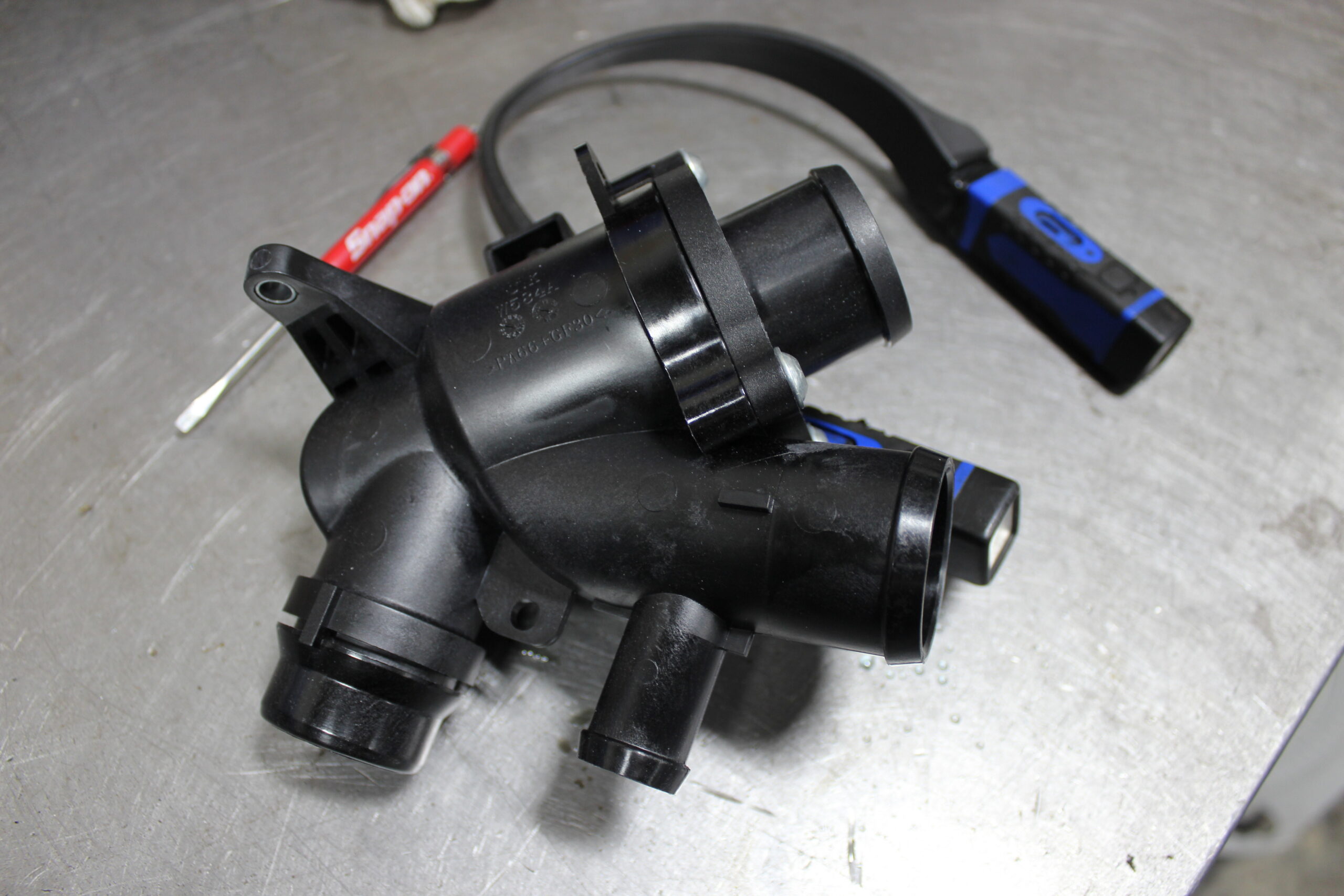
Land Rover’s 3.0L Supercharged V6, 5.0L Naturally Aspirated V8, and 5.0L Supercharged V8 engines are designed for strong performance and high horsepower, but with that power comes a significant amount of stress to the cooling system, which is largely built out of a plastic-like composite material. In particular, the thermostat assembly on these engines is integrated into one of these plastic-composite housings with multiple attached coolant passages and integrated sensors. Over time, and after many repeated heat cycles, internal coolant pressure causes this housing (and other coolant parts) to become brittle. As they weaken, cracks develop and rubber seals/gaskets tear, leading to coolant leaks.
In addition to leakage-related failure, the internal thermostat mechanism itself can malfunction. A thermostat that sticks closed can cause rapid overheating, while one that sticks open may prevent the engine from reaching proper operating temperature. Electrically, as well, the internal sensors can short-circuit, triggering fault codes and a “check engine” light.
©2026 Precision Motorworks
Symptoms of a Bad Land Rover Thermostat
Recognizing the symptoms of a failing thermostat early can prevent far more serious engine damage. One of the most obvious warning signs is an overheating message or temperature warning on the dash. As mentioned, coolant leaks are also common, often visible as dried white or orange residue near the front of the engine in the engine bay. Some owners may notice that the the heater only blows cold air since the engine is unable to reach proper operating temperature as a result of a stuck thermostat. Electronic failures within the thermostat assembly can also trigger check engine lights and fault codes related to coolant temperature regulation.
Land Rover thermostat issues should never be ignored as these engines are highly sensitive to overheating, and even a brief temperature spike can cause internal damage. Overheating may lead to warped cylinder heads, cylinder bore scoring, and full engine seizing, among other issues. Further, when coolant leaks in the engine from certain components, the coolant itself can also drip onto surrounding components, accelerating wear on belts and other nearby parts. What begins as a small seep can quickly turn into a costly repair if left unaddressed.
When Land Rover owners come in with coolant concerns, our technicians take a number of critical steps to ensure the best repairs are performed. The technicians will scan for fault codes to check for signs of overheat messages. They also will perform a cooling system pressure test, inspecting the thermostat and surrounding cooling components including coolant flanges, crossover pipes, the water pump, attached hoses, and seals/gaskets. At Precision Motorworks, proper thermostat repair involves replacing not just the thermostat housing assembly but the other adjacent coolant components under the intake and supercharger as well. After the necessary replacements, the cooling system is carefully vacuum-filled and bled to eliminate air pockets, which is critical on Land Rover engines, then retested for any remaining leaks or concerns.
If your Land Rover is approaching higher mileage and has not had cooling system service, a preventative inspection can help identify weaknesses before they lead to breakdowns. Proactive maintenance provides peace of mind and protects your investment.
If you suspect your Land Rover’s thermostat may be failing, or if you have noticed any of the mentioned symptoms, it’s best to trust the Land Rover specialists at Precision Motorworks. Our skilled repair team in Seattle has extensive experience diagnosing and repairing Land Rover cooling systems and understands the specific design challenges of these V6 and V8 engines, especially when it comes to the common thermostat failures. Do not hesitate, and call Precision Motorworks at (206) 282-1000 to schedule an appointment today!

For Land Rover Repair & Service
Call or Text:
206-282-1000
Email us at: service@precisionmotorworks.net